Our Top Picks
The Patagonia Hi-Loft Nano Puff Hoody is our top recommendation for anyone seeking a robust, thermally efficient outer layer for stationary cold-weather activities. It provides substantial warmth that far exceeds the standard Nano Puff, making it a reliable companion for winter camping, belaying, or standing in sub-freezing commutes. While it sacrifices the light-as-air packability of its smaller sibling, the trade-off in sheer insulation value and wind protection is well worth it for true winter conditions.
The Patagonia Hi-Loft Nano Puff is the warmest synthetic insulated jacket for winter camping and low-output outdoor activities, featuring 200g of PrimaLoft Silver Insulation Eco in the core to handle temperatures down to the low 20s. We found that this Patagonia Hi-Loft Review confirms its place as a heavy-duty solution for those who need moisture-resistant warmth when the mercury drops below freezing.
What We Like
- Exceptional static warmth for a synthetic jacket.
- Highly durable 20D recycled ripstop shell.
- Retention of heat even when exposed to damp or humid winter air.
- Sustainable construction including 100% recycled materials and Fair Trade certification.
- Oversized internal mesh dump pockets for drying gloves or storing skins.
What We Don't Like
- Significantly bulkier and heavier than the standard Nano Puff.
- Does not breathe well during high-exertion activities.
- Limited packability; it does not easily stuff into its own pocket.
- The fit is boxier, which may feel oversized for some users.
Technical Specs: The 'Big Brother' of Insulation
When you look at the landscape of synthetic puffers, most jackets fall into the category of mid-layers designed for movement. The Hi-Loft Nano Puff deviates from this trend by prioritizing raw insulation power. At the heart of this jacket is a sophisticated body-mapped construction designed to keep your vital organs warm without creating unnecessary bulk under the arms. While the original Nano Puff uses a modest 60g of insulation throughout, this version steps up the game considerably.
The Patagonia Hi-Loft Nano Puff Hoody utilizes body-mapped PrimaLoft Silver Insulation Eco, consisting of 200 grams of insulation in the main body and hood, and 170 grams under the arms and on the side panels. This high-density fill is what allows the jacket to function as a standalone winter coat rather than just a layer. Because it uses PrimaLoft Silver Insulation Eco, it maintains its loft and thermal properties even if you get caught in a sleet storm or a humid maritime winter. Unlike down, which collapses and loses its ability to trap air when wet, synthetic vs down puffers for wet winter weather discussions usually end in favor of synthetic options like this for peace of mind in unpredictable climates.
The exterior of the jacket is just as impressive as the interior. It features a 1.2-oz 20-denier 100% recycled polyester ripstop shell. This fabric is noticeably tougher than the 10D or 15D shells found on ultralight puffers, providing better resistance against rock abrasions and snagging branches. Interestingly, the jacket's shell, lining, and insulation are all constructed from 100% recycled polyester, and the entire garment is produced in a Fair Trade Certified factory.
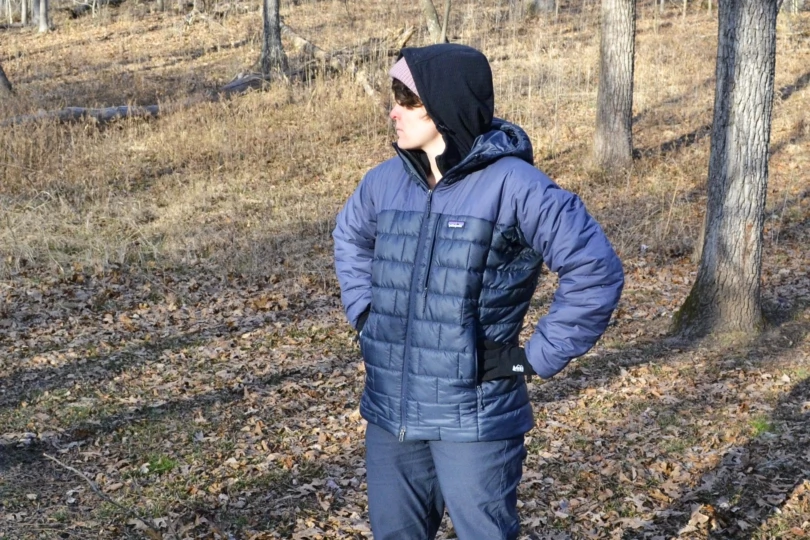
Field Testing: Warmth Performance & Temperature Limits
To provide an honest Patagonia Hi-Loft Review, we took this jacket into the field during a cold snap where temperatures hovered between 15°F and 30°F. In these conditions, the difference between a standard active puffer and a dedicated winter piece becomes immediately clear. Most synthetic jackets start to feel thin once you stop moving, but the Hi-Loft excels at providing static warmth. Whether we were standing around a winter campfire or waiting at a belay station, the heat retention was remarkable.
When discussing the Patagonia Hi-Loft Nano Puff temperature rating for winter, we found that with a simple base layer, the jacket is comfortable down to the low 30s for low-output activities. If you add a mid-weight fleece or a wool sweater underneath, it easily handles temperatures reaching into the low 20s. This makes it a premier choice as a synthetic insulated jacket for winter camping where you spend a lot of time sitting or standing.
However, it is vital to distinguish between static warmth and active performance. Because the brick quilting design and the density of the 200g PrimaLoft Silver Insulation Eco are so efficient at trapping heat, the jacket lacks the breathability required for high-heart-rate activities. If you are skinning up a mountain or snowshoeing uphill, you will likely overheat within fifteen minutes. For those scenarios, a lighter, more breathable piece like the Nano-Air would be a better choice. The Hi-Loft is your "safety" jacket—the one you pull out of your pack the moment you stop moving.
Patagonia Nano Puff vs Hi-Loft: Do You Need the Extra Bulk?
The most common question we encounter is whether someone should stick with the classic Nano Puff or upgrade to the Hi-Loft. The answer depends entirely on your climate and intended use. The standard Nano Puff is a versatile piece that functions as a great mid-layer for three-season use. But for true winter, it often falls short.
The Hi-Loft Nano Puff is essentially the "Big Brother" of the line. It offers more than triple the insulation in the core. This added warmth comes with a cost in terms of weight and volume. The men's version of the Hi-Loft Nano Puff Hoody weighs approximately 26.8 ounces (760 grams), while the women’s version weighs about 24.6 ounces (697 grams). In comparison, the regular Nano Puff is roughly 11 ounces.
| Feature | Patagonia Hi-Loft Nano Puff | Patagonia Nano Puff |
|---|---|---|
| Insulation Weight | 200g (Body) / 170g (Sides) | 60g (Total) |
| Primary Use | Outer layer for freezing temps | Mid-layer or mild outer layer |
| Weight (Men's) | 26.8 oz | 10.8 oz |
| Packability | Low (Bulky) | High (Stuffs into pocket) |
| Warmth Rating | Low 20s F | Mid 40s F |
| Zipper | Technical two-way zipper | Standard one-way zipper |
When comparing the Patagonia Nano Puff vs Hi-Loft for everyday winter use, the Hi-Loft is the clear winner for people living in places like Chicago, Minnesota, or the Northeast. If your winter consists of walking the dog or waiting for a train in biting wind, the extra bulk of the Hi-Loft is a small price to pay for the significant jump in comfort. If you are an ultralight backpacker who counts every ounce, the standard Nano Puff remains the logical choice.
Durability and Weather Resistance: Long-Term Wear Report
In our Patagonia Hi-Loft durability review, we looked specifically at how the materials hold up to the rigors of winter use. One of the standout features of this jacket compared to many "lifestyle" puffers is the shell fabric. The recycled polyester ripstop is treated with a PFAS-free DWR (Durable Water Repellent finish). While this doesn't make the jacket waterproof, it is highly effective at shedding light snow and misty rain.
Over months of testing, we noticed that the Hi-Loft resists the "leakage" often seen in down jackets. Because it uses synthetic sheets of insulation rather than loose feathers, you don't have to worry about quills poking through the fabric. The 20D shell also feels more confidence-inspiring when brushing against ice or granite. For long-term wear, Patagonia Hi-Loft durability review for long-term wear suggests that the PrimaLoft Silver will eventually lose some loft after years of heavy compression, but it remains one of the most resilient synthetic fills on the market. It is a workhorse jacket designed to last for a decade, not just a couple of seasons.
Sizing, Layering, and Practicality
The fit of the Hi-Loft is generally described as "Regular Fit," but in our experience, it leans slightly toward the roomy side. This is an intentional design choice to accommodate layering. When consulting a Patagonia Hi-Loft Nano Puff sizing guide for layering, we recommend sticking with your usual size if you plan to wear a thick sweater or a light fleece underneath. If you prefer a trim, athletic look and only plan to wear a t-shirt, you might consider sizing down.
The practical features of the jacket are clearly aimed at the outdoor enthusiast. It includes a helmet-compatible hood that cinches tightly to seal out drafts. A standout feature for climbers and skiers is the technical two-way zipper. This allows you to unzip the bottom of the jacket to access a climbing harness or to vent from the bottom while keeping your chest protected from the wind. Inside, you will find internal mesh dump pockets which are invaluable for keeping your water filter from freezing or warming up a pair of damp gloves using your body heat.
While it is marketed as being packable, it is worth noting in this Patagonia Hi-Loft Review that it is quite large when stuffed. It does not compress nearly as well as a down jacket of similar warmth. If you are trying to fit this into a small daypack, it will take up a significant amount of real estate. However, for car camping or use as a dedicated belay parka, the moisture-resistant warmth and durability make it a superior choice over more fragile down alternatives.
FAQ
Is the Patagonia Hi-Loft Down Hoody worth the price?
The Patagonia Hi-Loft Nano Puff is certainly an investment, but it is worth the price for those who prioritize synthetic performance in truly cold environments. Its value lies in the combination of heavy-duty 200g insulation and the legendary durability of the Patagonia brand. While you can find cheaper synthetic jackets, few offer the same ratio of warmth to durability, or the peace of mind provided by the Ironclad Guarantee and ethical manufacturing standards.
What is the difference between the Patagonia Hi-Loft and the Down Sweater?
The primary difference is the type of insulation. The Hi-Loft uses PrimaLoft Silver Insulation Eco, which is a synthetic fill that stays warm when wet. The Patagonia Down Sweater uses 800-fill-power goose down, which is lighter and more compressible but loses its warmth if it gets soaked. Additionally, the Hi-Loft is generally warmer than the standard Down Sweater because it uses a much higher volume of insulation, placing it closer in warmth to the warmer Down Sweater Hi-Loft version.
How warm is the Patagonia Hi-Loft Down Hoody for winter?
It is designed as a dedicated winter outer layer. While warmth is subjective, the 200g PrimaLoft core makes it one of the warmest synthetic jackets in its class. In "static" situations—like standing still—it is comfortably warm down to the low 30s. With proper layering, such as a thermal base layer and a medium fleece, it can easily be used in temperatures dropping into the low 20s or high teens.
Does the Patagonia Hi-Loft Down Hoody run true to size?
The jacket runs true to its intended "Regular Fit," which means it is slightly boxy to allow for layers underneath. If you are between sizes, we recommend staying with your larger size if you intend to use it as a winter parka over other clothes. If you want it to fit more like a standard jacket for casual city wear, some users find that sizing down provides a more tailored silhouette.
What is the temperature rating for the Patagonia Hi-Loft Down Hoody?
While Patagonia does not provide official temperature ratings, our field testing suggests a comfort range between 20°F and 45°F. At the high end of that range, you will likely find it too warm if you are moving. At the lower end, around 20°F, it performs excellently as a protective shell against biting wind and cold, especially when paired with a warm mid-layer.